
Wuthering Waves Gameplay Experience and Fun Factor
Wuthering Waves is fun in 2026, offering polished combat and engaging exploration for action RPG fans on PC, PS5, and mobile.
Whether Wuthering Waves is fun in 2026 really comes down to what you want from it. If you're here for tight action combat, boss practice, and that "one more run" feeling when your execution gets cleaner, then yes — very much so. Kuro Games has spent the last two years turning a messy launch into a genuinely polished live-service action RPG, and right now WuWa feels far more confident about what it wants to be. In this article, we're breaking down the big pieces that decide the answer: combat, exploration, story, grind, gacha, and how the game feels on PC, PS5, and mobile.
Is Wuthering Waves Fun Right Now
Right now, the short version is pretty simple: Wuthering Waves is fun, but not for everyone in the same way. By 2026, most of the launch-era roughness is no longer the main story. Version 2.0 and Rinascita were the real turning point, and the patches after that — through Version 3.2 and the wider 3.x cycle — kept improving the game without sanding off its identity.
Quick verdict by player type:
| Player Type | Fun Rating | Notes |
|---|---|---|
| Combat-first | ★★★★★ | Core loop built specifically for this player |
| Exploration enthusiast | ★★★★☆ | Fluid traversal, expanding regions |
| Story-first | ★★★☆☆ | Improved since Rinascita, still uneven |
| Casual mobile-only | ★★☆☆☆ | Touch controls limit hard content |
| F2P strategist | ★★★★☆ | Generous Astrite income rewards planning |
If you like reaction-based combat, don't mind some RNG in your gear grind, and are fine with a live-service rhythm of roughly one patch every six weeks, WuWa is a very strong fit. If you mainly want a tightly written narrative from the first hour or expect a traditional JRPG-style story experience, it's a much shakier recommendation. That's honestly the cleanest way to answer is Wuthering Waves fun in 2026: it's excellent for the right player, and only decent for the wrong one.
Wuthering Waves Combat Fun Factor
Parry and dodge loop
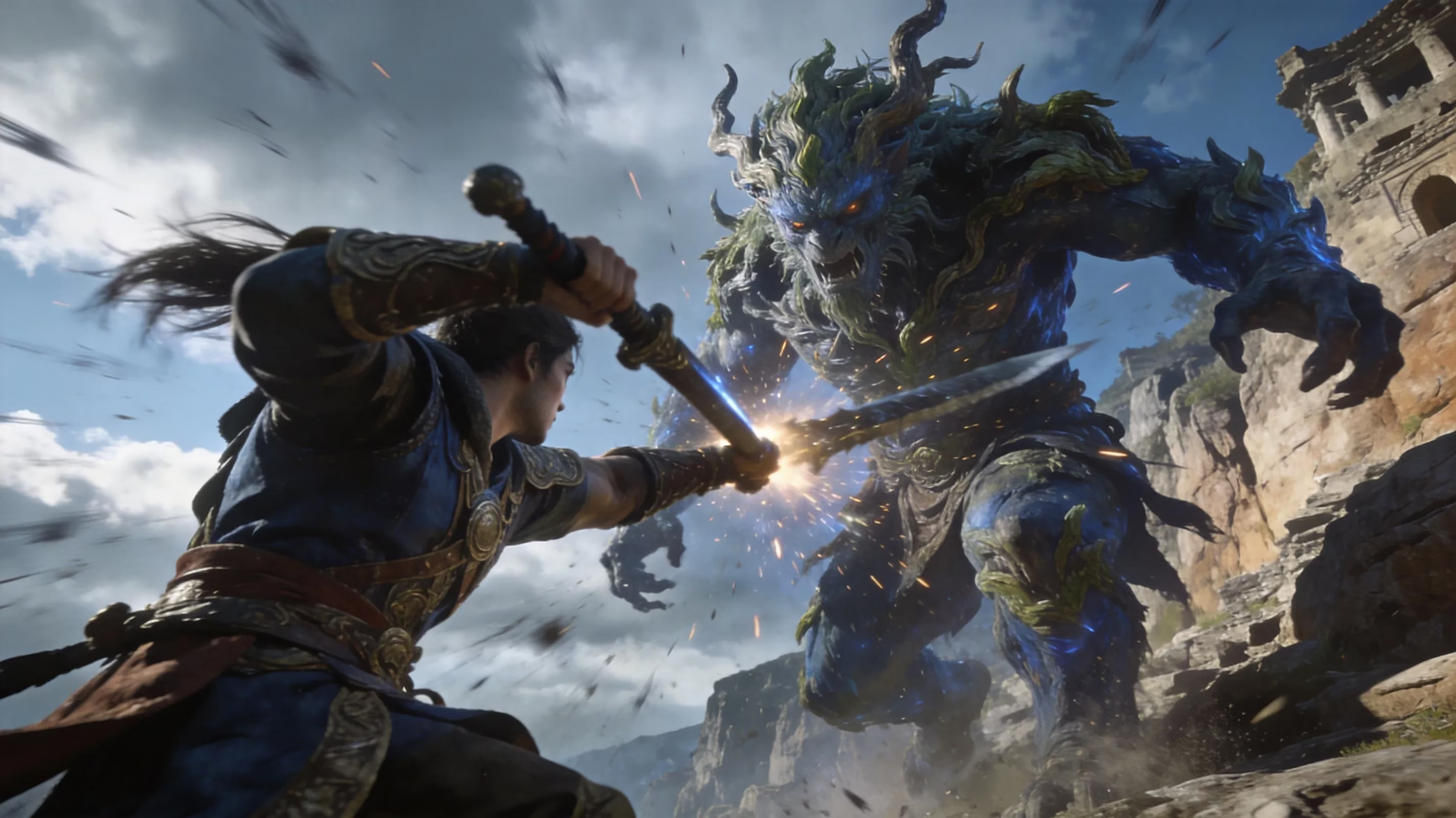
This is where Wuthering Waves wins people over. Combat is built around reactions and timing more than simple cooldown cycling, so the game feels best when you're reading enemy patterns instead of just pressing whatever lights up next. Land a parry at the right moment and you crack the enemy's posture for a punish window that feels earned, not handed to you.
Perfect dodges add a brief slow-time effect, which gives fights a really satisfying counterattack rhythm once it clicks. The timing isn't brutally strict in a Souls-like way, but it's precise enough that better play is obvious almost immediately. If you fight the same boss ten times and your clear time drops by 30 seconds just because your parries got cleaner, that's the loop working exactly as intended.
Team rotation depth
The real standout, though, is the swap system. Intro and Outro skills make switching characters part of your damage plan, not just a panic button or a reset. Every exit matters, every entry matters, and that gives team rotations way more texture than a lot of other gacha action RPGs.
Then you add Forte gauges on top of that, and the skill ceiling goes up fast. Some characters cash them out for burst windows, some use them to shift stance, and others change their attack flow entirely. Once you start lining up Forte usage, Outro buffs, Intro attacks, and Resonance Liberation timing inside stagger windows, combat stops feeling like isolated button presses and starts feeling like a proper combo sequence. In endgame, that payoff is huge.
Endgame combat modes
WuWa's endgame is a big reason the combat stays fun instead of burning bright and fading out. In 2026, three modes do most of the heavy lifting.
The Tower of Adversity is the permanent timed gauntlet. It asks for two built teams and rewards clean, efficient execution, so it's the mode where roster planning and mechanics meet.
The Endstate Matrix, added in Version 3.2 and running through Version 3.4 as the Doomsday Cycle, is tougher and more demanding. It pushes roster depth, enemy knowledge, and buff matching across multiple rounds, so you can't really autopilot it. Bosses like Thundering Mephis, Impermanence Heron, and Sigillum all punish sloppy play in different ways, which is exactly what combat-focused players want.
Then there's Blade Hunter: Wilderness, introduced in Version 3.1. It's a wave survival mode with a roguelike-adjacent structure, and that high-variance run-to-run feel gives it strong replay value. Between those three modes, players who log in mainly for combat have enough hard content to keep the game fresh.
Wuthering Waves Exploration and Story Fun
Open-world traversal feel
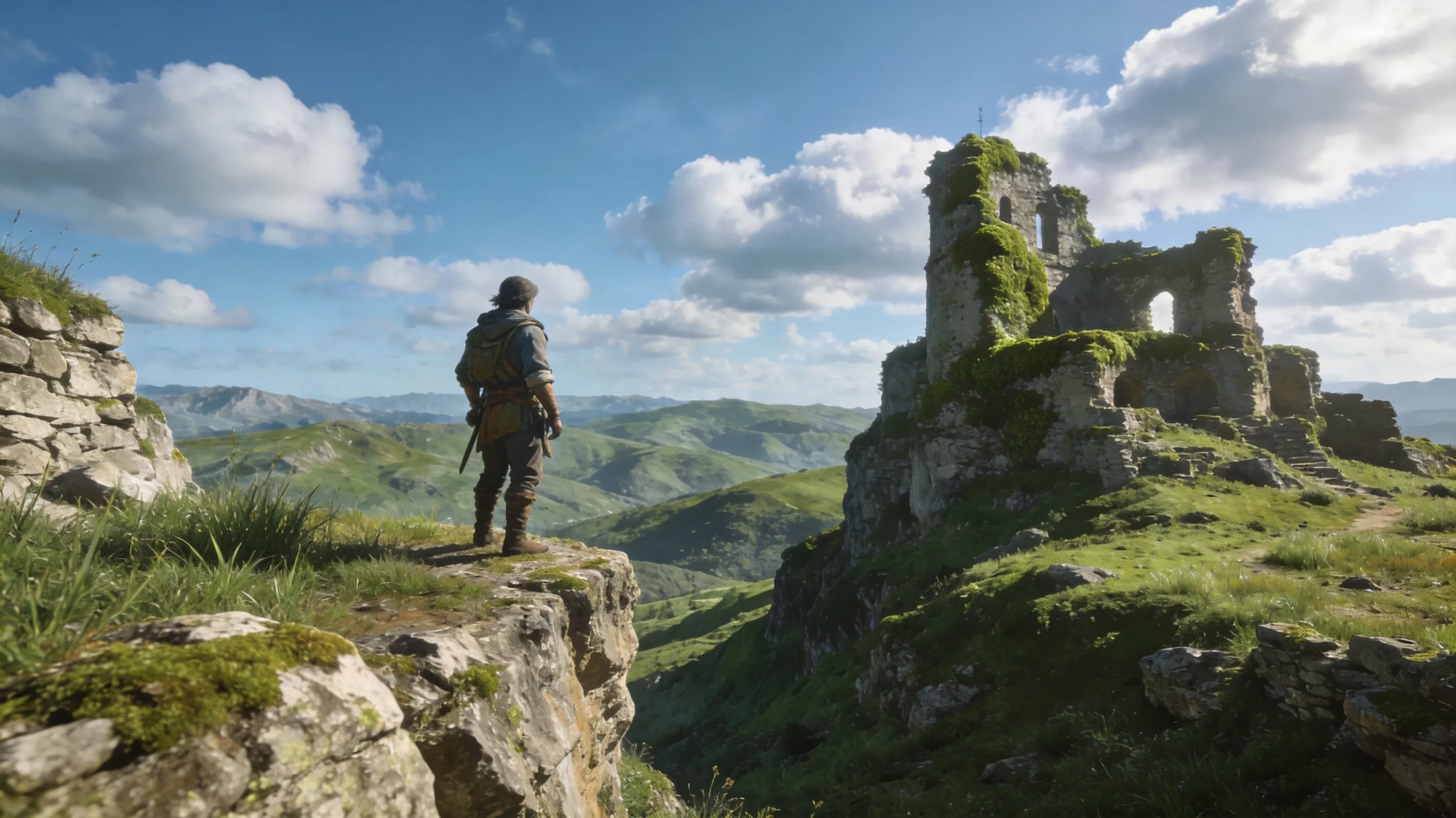
Exploration is one of WuWa's quieter strengths. Movement is fast, vertical, and just snappy enough that getting around rarely feels like dead time. You can wall-run on certain surfaces, chain jumps and dashes, and move through elevation changes much faster than in most open-world gachas.
The Echo hunting loop helps a lot here too. Since overworld enemies can drop captureable Echoes that feed directly into your build progression, random fights out in the world usually feel worthwhile. You're not just clearing mobs for the sake of it — there's a practical reward attached.
The 3.x updates also did a good job of keeping regions visually distinct. Rinascita's Mediterranean-inspired look feels very different from the harsher industrial, post-apocalyptic feel of earlier zones, and that contrast matters. New areas don't just look like recolors of old ones, which keeps exploration sessions from blending together.
Story enjoyment in 2026
The story is better now, but the early criticism didn't come from nowhere. The opening chapters are still the game's weakest stretch, mostly because they lean too hard on lore density, uneven pacing, and dialogue that asks you to care before it has really earned that investment.
Rinascita is where things noticeably improve. The cinematic direction gets stronger, the character writing tightens up, and the game finally starts landing emotional beats with more confidence. The Cartethyia chapter in particular — with its original vocal track and high-budget cutscenes — is still one of the clearest examples of WuWa hitting the level players wanted from the start.
That upward trend continues in the 3.x story patches, including Version 3.2's Gold Suspended in Shadows arc. The soundtrack deserves real credit too. WuWa's music has been consistently strong across its whole lifespan, and several tracks have reached well beyond the game's immediate playerbase. If you can push through the early chapters, the narrative experience from Chapter 2 onward is meaningfully better.
Wuthering Waves Grind, Gacha, and Burnout
Echo farming reality
If there's one system that still splits the playerbase, it's Echo farming. On paper, the Echo system is cool: instead of standard artifact pieces, you equip remnants from defeated enemies for stat bonuses and set effects. It fits the game's identity well, and mechanically it's more interesting than a plain gear menu.
The problem is the RNG stack. You're dealing with drop rate, main stat, substats, tuning rolls, and cost distribution — five separate layers, which is a lot no matter how patient you are. That frustration is real.
Version 3.2 helped, especially on the quality-of-life side. Batch discard, smarter auto-discard filters, and importable plan codes made inventory management much less annoying, even if the actual randomness underneath didn't change. The healthiest way to approach Echoes is to stop at "good enough" unless you genuinely enjoy min-maxing. A functional set with the right stats clears all PvE content. Perfect substats are optional, not mandatory.
Gacha fun or stress
The convene system uses an 80-pull hard pity for 5-star Resonators, with the usual 50/50 split between the featured unit and a standard banner character. In the worst-case scenario, if you lose the 50/50 and don't already have guarantee, you can need up to 160 pulls for the exact featured character you want.
That sounds harsh, but WuWa softens it with pretty generous Astrite income. Version 3.2 gave out more than 10,600 Astrites through events, exploration, and login rewards, which worked out to roughly 102 free pulls across the patch cycle. For F2P players, that means planning actually works. Save across two or three patches and you can realistically lock in a target.
So, is the gacha fun? Sometimes. Is it stressful? Also yes. The 50/50 always carries tension. But because the pity system is transparent, it feels more like resource planning than a total black hole. And honestly, a lot of the fun comes from pulling for different playstyles rather than chasing raw account power.
Time commitment check
WuWa is not especially demanding day to day unless you make it that way. A normal daily routine usually takes around 20 to 30 minutes, covering dailies, data bank refreshes, and whatever event is currently active. That's manageable for most players.
Longer sessions mostly come from endgame pushes like Tower of Adversity or Endstate Matrix. Casual players can absolutely keep up with story and routine account progress without touching the hardest content, while more dedicated players have enough systems to sink hours into optimization.
Burnout risk is moderate. The six-week patch cycle keeps things moving, but it can start to feel relentless if you treat every event like mandatory homework. The best way to avoid that is pretty simple: don't try to clear everything at max efficiency just because it exists.
Is Wuthering Waves Fun on PC, PS5, and Mobile
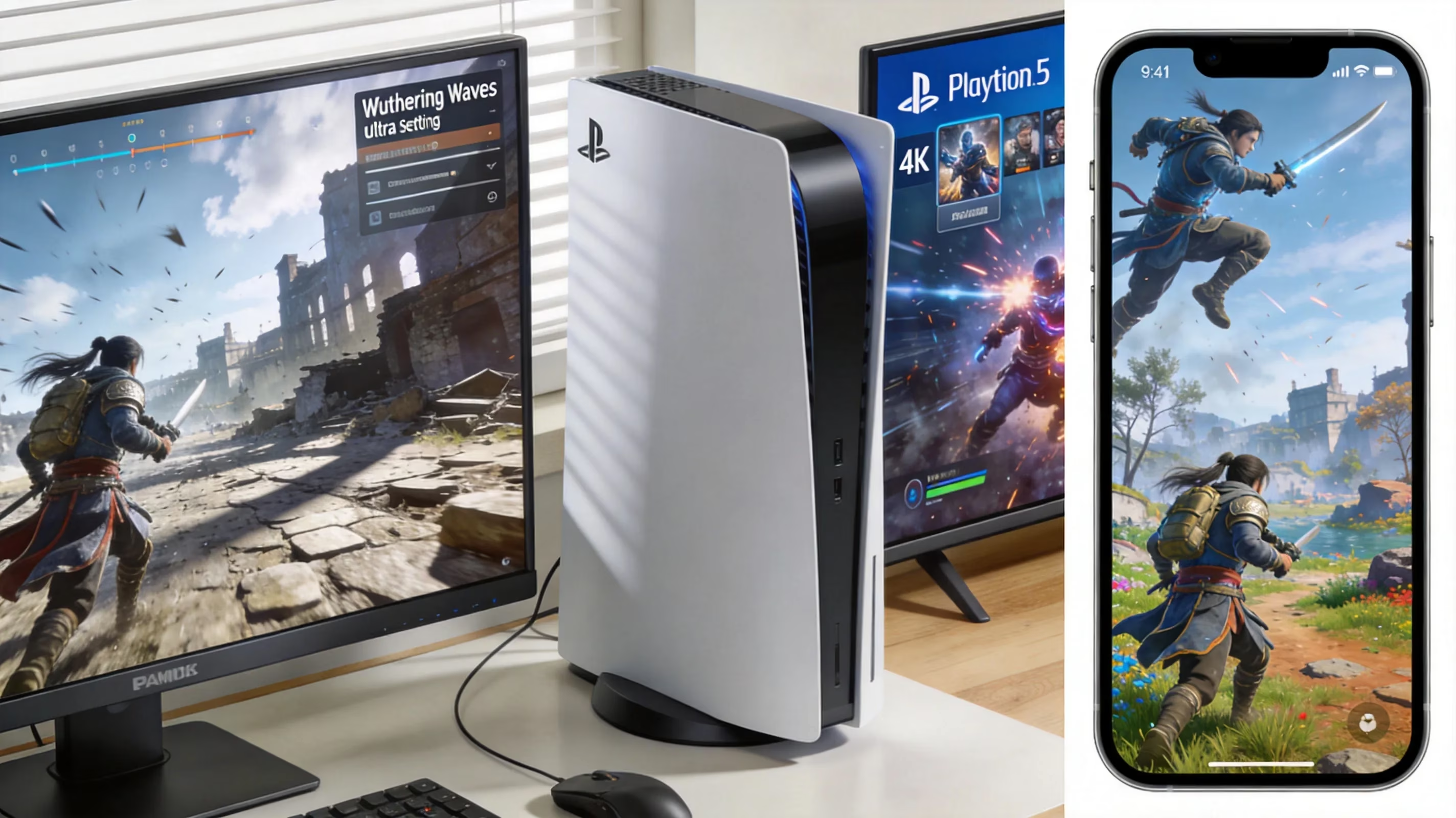
Platform matters a lot more here than it does in many similar games. Because WuWa's combat is so timing-sensitive, input feel isn't a minor detail — it directly affects how fun the game is.
On PC, Wuthering Waves feels best. Inputs are responsive, parry timing feels fair and consistent, and you have more freedom to tune performance versus visual quality. Keyboard and mouse works fine, but a lot of players eventually switch to controller because it's just more comfortable for longer sessions.
On PS5, the game is also in a very good spot. The controller fits the swap-heavy combat naturally, DualSense haptics make dodges and parries feel more tactile, and the big-screen setup helps the game's cinematic moments land better. If you prefer couch play, PS5 is a legit primary platform rather than a compromise.
Mobile is where the recommendation gets more conditional. Yes, the game is playable on strong Android and iOS devices, and cross-progression makes it great for quick daily check-ins. But hard fights expose the limits fast. Parry timing is less reliable on touch controls, swap speed suffers because of button placement, and long sessions can run into thermal throttling.
Native controller support on mobile helps a lot, and if you're willing to use one, the gap closes noticeably. Still, for difficult boss content, mobile remains the weakest way to play.
Cross-progression across PC, PS5, and mobile is fully supported, and that's a bigger convenience than it sounds. Being able to do dailies on your phone and then handle serious combat on PC or PS5 is genuinely useful.
Is Wuthering Waves Fun for You
Combat-first players are the easiest yes. If you enjoy learning boss patterns, tightening rotations, and feeling your own execution improve, Wuthering Waves is hard to put down. The parry-dodge-swap loop has enough depth that mastery feels rewarding, not fake-deep.
Story-first players should be a little more cautious. The story does improve, and it improves a lot after Rinascita, but the first stretch still asks for patience. If narrative is your main reason for playing, you probably need to reach that point before making a final call.
F2P players are in a good spot overall. The Astrite economy supports long-term planning, and all PvE content is clearable without spending. The real cost is discipline — skipping banners, saving currency, and accepting that you can't have everything.
Spenders mostly buy flexibility, not a free pass. You get more roster options and less banner stress, but you don't get to skip the Echo grind with money, and the game's PvE content still rewards mechanics more than wallet size.
Returners who bounced off the launch version should seriously consider giving it another shot. The 2026 version is better paced, fuller on content, and much smoother on the quality-of-life side. The 3.x era feels like the game finally settling into its best form.
New players can jump in without much trouble. The onboarding got streamlined in Version 2.0 and has been refined since, so getting into current, endgame-relevant systems is much faster than it was at launch.
Conclusion
If you love reactive combat, strong boss design, and a live-service game that actually gives you room to get better at it, Wuthering Waves is one of the best options in the genre going into mid-2026. Kuro Games has been consistent with patch delivery, noticeably more responsive to feedback than it was at launch, and pretty good at adding quality-of-life improvements without flattening the game's identity. The main friction points are still there — Echo RNG, a shaky early story, and weaker mobile controls — but for combat-focused players, they usually don't outweigh the upside.
You should be more cautious if you need a great story from hour one, play only on mobile without a controller, or absolutely hate layered gear RNG. Those are still the pressure points, and they matter.
The best way to start in 2026 is honestly the simplest one: just play the first five to seven hours and see whether the combat clicks. Is Wuthering Waves fun becomes much easier to answer once you've felt that early parry-counter-swap rhythm for yourself. If that part lands, the game only gets better from there.
Comments