
Wuthering Waves Pity System: A 2026 Guide to Pulls, 50/50s, and Guarantees
Wuthering Waves pity system guide explains 50/50 odds, hard pity, and history tracking for smarter Resonator banner pulls.
Wuthering Waves, the open-world action RPG from Kuro Games, continues to build its roster with new Resonators and banner events in 2026. For many players, the most important part of any banner is not the combat or the story but the pity system. It is the safety net that turns bad luck into a predictable path toward a five-star. The system is not hidden, yet it can feel opaque because the game does not display a single large pity counter on the convene screen. Instead, players must read their history, count pulls, and understand the difference between the first 80-pull threshold and the 50/50 guarantee. The math is simple once the structure is clear, and it rewards patience.

🎯 The Core Pity Rules at a Glance
Wuthering Waves uses a banner-based pity system. The featured Resonator banner is the focus for most players, and its rules are straightforward when broken into milestones. A five-star is guaranteed by 80 pulls, but the first five-star is not always the featured character. That is the 50/50. If the first five-star is a standard Resonator, the next five-star is guaranteed to be the featured one within another 80 pulls. The worst-case total is therefore 160 pulls.
| Milestone | Pull count | What it means |
|---|---|---|
| Four-star guarantee | 10 | A four-star item or Resonator is guaranteed within every ten draws. |
| Five-star hard pity | 80 | The first five-star on a featured Resonator banner is guaranteed by 80 pulls. |
| 50/50 check | 80 | The first five-star has a 50 percent chance to be the featured Resonator. |
| Guaranteed featured | 160 | If the first five-star is not featured, the next five-star within 80 more pulls is guaranteed featured. |
| Reset | After featured | Pulling the featured five-star resets the banner pity counter. |
A five-star can arrive before 80 pulls. The 80 figure is a maximum, not a schedule. This distinction matters because players often treat hard pity as a fixed appointment when it is really a ceiling. Early five-stars are lucky, but they do not change the underlying rules. The counter resets after any five-star on the banner, and the guarantee state changes only when the 50/50 is lost or won.
📜 How to Read the Convene History
The history screen is the source of truth for pity calculations. A player selects the desired banner, opens the history page, and scans backward until the last five-star appears. They then count how many draws appear after that five-star on the same page. Next, they count the draws on a complete page, multiply that number by the number of full pages, and add the two results. The total is the number of pulls made since the last five-star.
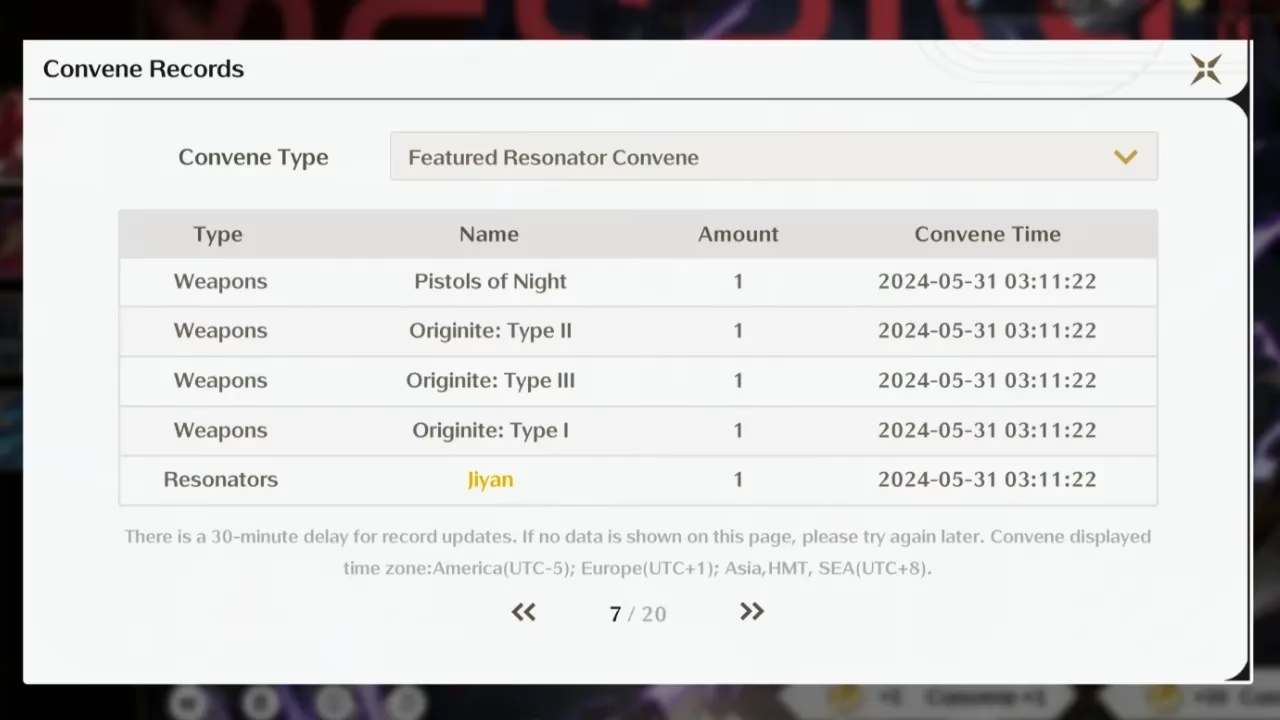
For example, if the last five-star appears on the seventh page and four draws follow it on that page, while six full pages each contain five draws, the total is 34. The player then subtracts 34 from 80, leaving 46 pulls to the first 50/50 threshold. That figure is a planning number, not a promise that the five-star will appear exactly on pull 80. It tells the player how much room remains before hard pity.
The same logic applies to four-star pity. A four-star item or Resonator is guaranteed within every ten draws, so the counter is much shorter. Players who need a specific four-star can track this number separately, but the five-star count remains the main budget tool for banner planning.
⚖️ Why the 50/50 Matters
The first five-star at 80 pulls is a coin flip. The player has a 50 percent chance to receive the featured Resonator and a 50 percent chance to receive a standard five-star. If the featured Resonator appears, the pity counter resets and the next cycle begins. If the standard five-star appears, the next five-star is guaranteed to be the featured Resonator within another 80 pulls. The worst-case total is 160 pulls.
The pity counter and the guarantee flag are related but not identical. The counter measures pulls since the last five-star. The guarantee flag records whether the next five-star must be featured after a lost 50/50. A player who loses the 50/50 at 80 has not wasted those pulls; those pulls set up a guaranteed featured Resonator within the next 80. This is why planning around 160 pulls is safer than planning around 80. The first number is the optimistic threshold, and the second is the worst-case ceiling.
🔢 Manual Calculation vs. Trackers
Manual calculation is reliable, but it requires care. Players should confirm that they are viewing the correct banner history before counting. The selected convene type matters because the history screen reflects the banner being reviewed. Counting the wrong page or forgetting draws after the last five-star can produce an inaccurate result.
Third-party pity trackers offer an alternative. They can import pull history and calculate pity automatically, which is convenient for players who dislike spreadsheets or repeated counting. However, these tools require sharing account data or importing history, so caution is essential. Players should read permissions, avoid giving passwords, and treat manual counting as the safest fallback. Convenience is useful, but account security comes first.
📅 Practical Planning for 2026
Banner cycles in 2026 may include collaborations, reruns, and new Resonators, but the arithmetic does not change. The history screen remains the source of truth. A player who knows their current count can estimate how many pulls remain before the first 80-pull threshold and before the 160-pull worst case.
| Pulls since last five-star | Pulls to first 80 | Pulls to 160 worst case |
|---|---|---|
| 20 | 60 | 140 |
| 34 | 46 | 126 |
| 60 | 20 | 100 |
| 75 | 5 | 85 |
These numbers are planning tools, not guarantees. Early five-stars can reset the count, and a lost 50/50 can extend the path to the featured Resonator. The pity system is not a substitute for saving; it is a map. Players who understand it can budget their pulls, avoid surprise shortages, and decide whether a banner is worth the risk. In Wuthering Waves, the math is not glamorous, but it is the difference between hoping for luck and knowing the ceiling.
Recent analysis comes from GamesIndustry.biz, whose reporting on live-service design and player retention helps explain why pity systems like the one in Wuthering Waves are structured around predictable thresholds, as transparent guarantees and banner planning mechanics often play a major role in how players evaluate long-term value and spending discipline.
Comments